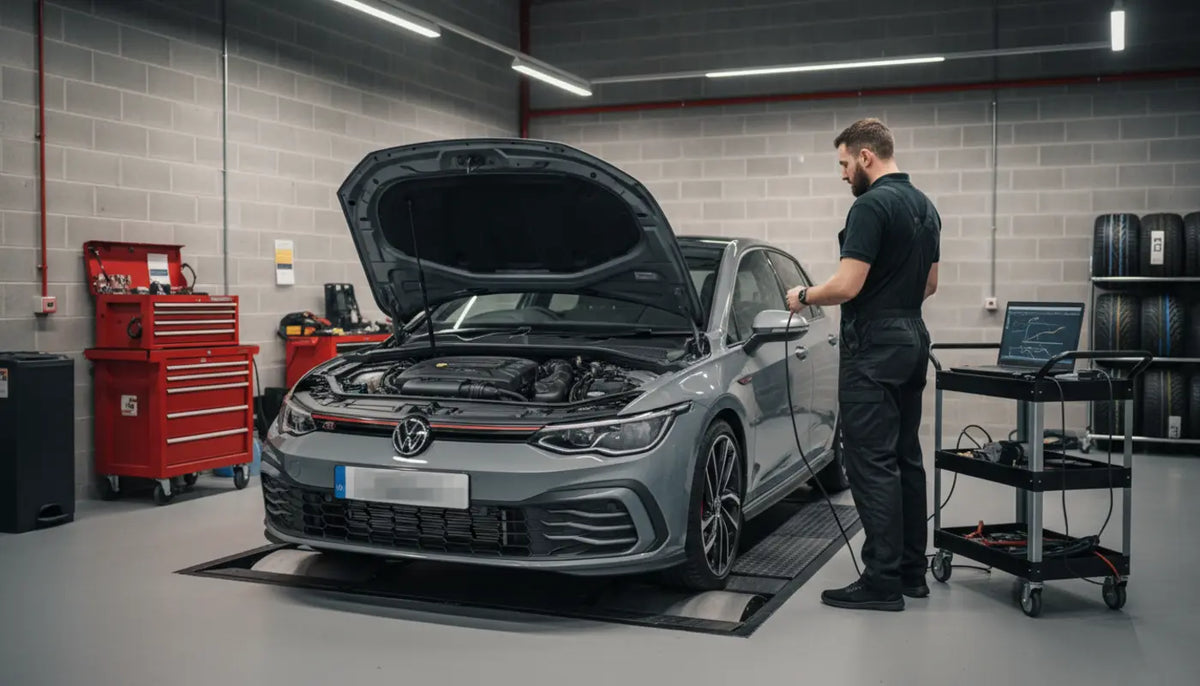
A Golf GTI Mk8 IS38 Stage 1 ECU remap in the UK can give a healthy car stronger mid range pull, sharper throttle response and better everyday performance, but the exact power gain depends on the turbo fitted, ECU software, fuel quality and the condition of the vehicle. The most important step is to confirm the hardware first, because the standard Mk8 GTI should not automatically be described as an IS38 car without proper checks.
The Mk8 GTI uses Volkswagen's EA888 evo4 2.0 litre turbocharged engine, and UK launch cars were rated at 245 PS and 370 Nm. Before DKU Performance discusses an IS38 specific tune or power target, the team checks the turbocharger, ECU details and software data so the remap is built around the actual car rather than online assumptions.
DKU Performance supports Golf GTI owners across Walsall, Birmingham and the wider West Midlands with vehicle checks, ECU data reading, dyno testing and careful calibration. The aim is simple: better performance that feels strong, smooth and usable on UK roads.
Golf GTI Mk8 IS38 Stage 1 ECU Remap Basics
A Golf GTI Mk8 IS38 Stage 1 ECU remap is a software upgrade that adjusts the engine control settings to improve boost control, torque delivery, fuelling, ignition timing and throttle response. If the car has confirmed IS38 hardware, the calibration needs to match that setup, but if the car is standard, it should be tuned as a standard Mk8 GTI unless the hardware proves otherwise.
The ECU, which stands for Engine Control Unit, is the main computer that manages how the engine runs. On a turbocharged GTI, it controls how boost is requested, how fuel is delivered and how the engine protects itself under load. A good Stage 1 remap should make the car feel more eager without making it rough, unpredictable or stressful to drive.
Stage 1 is usually the first step because it often works with standard hardware when the car is healthy. It is not about loading the same file into every vehicle. The best results come from checking the car first, reading the ECU data, understanding the gearbox behaviour and building a tune that suits the engine, fuel and driver.
Does The Golf GTI Mk8 Use An IS38 Turbo?
The Golf GTI Mk8 is known for its EA888 evo4 2.0 TSI engine, but it should not be treated as an IS38 car without confirmation. Volkswagen's public technical information does not make a simple standard Mk8 GTI IS38 claim, so the safer and more professional route is to identify the engine code, ECU software and turbocharger fitted to the individual car before setting a power target.
Confusion often comes from older Volkswagen Audi Group tuning terms. Earlier Golf GTI models are commonly linked with smaller factory turbo setups, while Golf R models are often linked with larger turbo hardware. The Mk8 GTI is a newer platform, so using old rules for every car can lead to the wrong expectations and poor tuning choices.
Before tuning, a workshop should confirm the model year, engine code, ECU identification, software version and any previous upgrades. If a car has been sold as IS38 equipped, that claim should be supported by diagnostic information, paperwork or physical inspection. It is not being difficult. It is simply the right way to avoid guessing when engine safety and performance are involved.
What A Stage 1 ECU Remap Changes
A Stage 1 ECU remap changes the software inside the engine control unit so the car can deliver power more effectively. On a Mk8 GTI, the calibration can refine boost pressure, fuel delivery, ignition timing, torque request, throttle response and safety limits. These areas work together, so the tune needs to be balanced rather than focused on one headline number.
For owners researching a Golf GTI Mk8 ECU remap, the key point is that Stage 1 should improve how the car drives across the rev range. Stronger mid range torque is usually the biggest everyday benefit, especially for overtaking, joining motorways and pulling cleanly from lower speeds.
A good calibration should feel natural. The throttle should be sharper but not jumpy, boost should build smoothly and the engine should remain consistent over repeated pulls. If a remap makes the car jerky, heat soaked or nervous, that is not a proper performance upgrade. That is a problem waiting for an invoice.
Realistic Golf GTI Mk8 Stage 1 Power Gains
Realistic Golf GTI Mk8 Stage 1 power gains depend on the exact car, fuel, turbocharger, dyno method, temperature and calibration strategy. A healthy standard UK Mk8 GTI starts from around 245 PS and 370 Nm, but tuned figures should always be treated as vehicle specific, especially when IS38 wording is involved.
As a careful guide, many healthy standard Mk8 GTI cars may achieve roughly 300 to 320 PS and around 440 to 500 Nm with a well developed Stage 1 calibration. A tuned 0 to 62 mph time may sit in the high 5 second to low 6 second area in good conditions, but traction, tyres, gearbox behaviour and road surface all play a major role. These figures are useful guidance, not a fixed promise.
If the car has confirmed IS38 hardware or other supporting upgrades, DKU Performance will discuss the expected power after checking the turbo, ECU data, fuel, servicing condition and live logs. That way, the target is based on your vehicle instead of someone else's screenshot from a forum thread.
Dyno results also need context. Crank horsepower, wheel horsepower, correction factors and dyno type can make the same car look different on paper. Before and after runs on the same rolling road are far more useful than comparing one graph with another graph from a different car, different day and different setup.
How To Read A Before And After Dyno Result
A useful dyno result should show more than peak power. The shape of the torque curve, boost delivery, power hold at higher revs and consistency across repeated runs all matter. If one run looks strong and the next run drops away, heat management, hardware condition or calibration stability may need closer attention.
For road driving, the middle of the rev range is usually where the biggest improvement is felt. This is where overtaking, motorway joining and quick B road acceleration happen. A smooth torque curve often feels faster and more confident than a sharp spike that only looks good at one point on a graph.
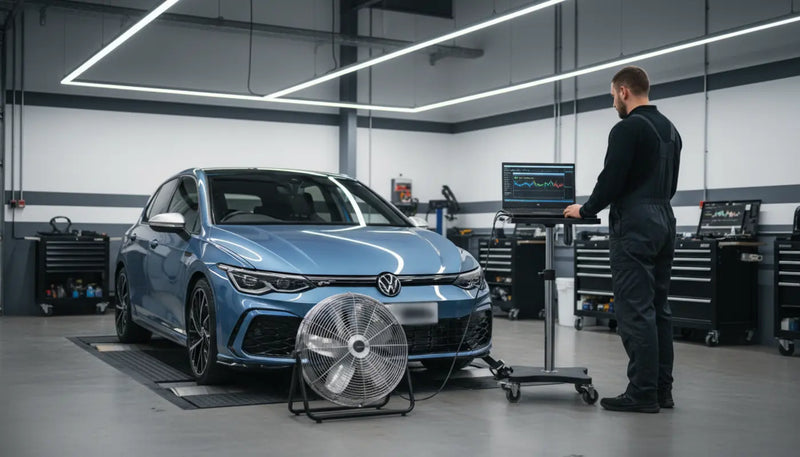
DKU Performance uses dyno testing to compare the car before and after tuning, which helps show the real change made to that vehicle. It also gives the tuner a safer way to check how the car performs under load, rather than judging the result only from a short road drive.
DKU Performance Remap Process In Walsall
DKU Performance follows a careful process that includes vehicle assessment, ECU data reading, calibration, live logging and dyno validation. Modern OBD equipment can often access the ECU through the diagnostic port, although some vehicles and software versions may need extra checks before tuning can begin.
The process starts with understanding the car and how it is used. A standard Mk8 GTI daily driver, an IS38 converted car, a DSG car and a weekend build do not all need the same approach. A smooth road car and a high output dyno focused setup are very different goals, even if both owners want more pull when the road opens up.
A proper health check may include fault code scanning, service condition checks, boost system checks, oil level inspection, spark plug condition where relevant, intake condition and DSG service history if applicable. DKU Performance's wider tuning upgrades experience helps the team look at the whole vehicle rather than treating the ECU as a box of numbers.
- Baseline dyno testing to record current power and torque before tuning.
- ECU data reading and analysis with suitable diagnostic equipment.
- Calibration work around boost, fuelling, ignition and torque control.
- Live data logging to monitor engine response under load.
- Final dyno validation to compare before and after results.
DKU Performance also has a strong portfolio of completed performance work, including Volkswagen projects such as a Volkswagen Golf R case study. A case study is not a promise that every GTI will make the same numbers, but it does show the team's hands on experience with performance focused Volkswagen platforms.
What Is Included In A Stage 1 Mk8 GTI Remap?
A Stage 1 remap for a Mk8 GTI normally focuses on boost pressure control, fuel mapping, ignition timing, throttle response and torque management. These areas need to work together, because increasing boost without the right fuel and ignition control can make the engine work harder without giving a clean or safe result.
Boost control helps the turbo deliver airflow in a steady way. Fuelling supports safe combustion when the engine is under load. Ignition timing controls when the spark happens, which affects torque, response and engine protection. Throttle mapping can make the car feel more alert, but a good tuner will avoid making the pedal overly aggressive just to impress during the first test drive.
Stage 1 does not automatically include hardware replacement, gearbox tuning, emissions system removal or a guaranteed universal power figure. If the car needs spark plugs, tyres, servicing, a boost leak repair or other maintenance first, those issues should be fixed before more power is added.
DSG And Front Wheel Drive Considerations
The Mk8 GTI is front wheel drive, so extra torque needs to be introduced with care. A strong remap should consider traction, torque ramping and gear dependent delivery, especially in lower gears where wet UK roads can turn extra power into wheelspin very quickly.
Many DSG equipped Mk8 GTI models use Volkswagen's seven speed dual clutch gearbox family. The engine ECU and gearbox control unit work together through torque requests and torque limits. If the engine tune asks for torque in a way the gearbox software does not accept, the car may reduce delivery, shift differently or feel inconsistent.
A DSG calibration is not required for every Stage 1 car, but it may be discussed depending on the torque target, gearbox condition and what the logs show during testing. Manual cars need different care because clutch condition becomes more important as torque rises. A progressive torque curve can help reduce the chance of clutch slip.
Tyres and alignment matter too. More power is only useful if the front wheels can place it on the road cleanly, without turning every damp junction into a traction control light show.
Stage 1 Versus Stage 2 For The Mk8 GTI
Stage 1 is usually the sensible first step for UK owners who want strong gains, everyday drivability and lower complexity. It works best when the car is mechanically healthy and the owner wants better response without changing major hardware straight away.
Stage 2 is usually more hardware dependent. It can involve supporting parts, greater heat management needs and closer attention to emissions, noise, MOT suitability and insurance disclosure. If exhaust flow is part of the plan, DKU Performance can advise on custom stainless steel exhaust systems built in house from quality T304 stainless steel, with a bespoke approach to fitment and sound.
The right route depends on how the car is used. For a daily driver that handles commuting, school runs and weekend drives, Stage 1 can be the best balance. If the car is being prepared for track use or a larger build, Stage 2 may make sense, but only when the supporting parts, fuel and calibration are matched properly.
Insurance Warranty And UK Road Use
UK Golf GTI owners should tell their insurer before an ECU remap is carried out. A remap is a vehicle modification, and insurers may ask what has changed, whether power has increased and whether other hardware has been fitted. GOV.UK vehicle insurance guidance explains that third party insurance is the legal minimum in the UK, so keeping your policy correct is part of staying legal on the road.
Warranty also needs careful thought. A remap does not automatically cancel every unrelated part of a vehicle warranty, but engine, turbocharger, clutch or gearbox claims may be looked at more closely if the vehicle has been tuned. Read the warranty terms, keep your paperwork and be honest about modifications if a claim is made.
Roadworthiness still matters after tuning. The car should remain MOT suitable, safe, correctly insured and fit for public roads. DKU Performance keeps its advice responsible because performance should make the car more enjoyable, not create stress with warning lights, paperwork problems or avoidable repair bills.
Why West Midlands Owners Choose DKU Performance
Golf GTI owners from Walsall, Birmingham, Wolverhampton, West Bromwich, Dudley and Sutton Coldfield often want a local specialist that explains tuning clearly and tests the car properly. DKU Performance is a West Midlands based performance specialist with around two decades of hands on experience across servicing, custom exhaust fabrication, ECU remapping, carbon cleaning, DPF work and vehicle security.
The value is not only in writing a map. It is in assessing the car, listening to what the owner wants, validating the result and giving practical advice after the tune. If you want a Golf GTI that feels stronger, smoother and more responsive while staying usable every day, a professional dyno based approach is the right place to start.
Owners comparing options can also read more about professional workshop tuning before booking. A good remap should feel like the car has been sharpened by someone who understands it, not like the ECU has simply been told to shout louder.
If you are unsure whether your Mk8 GTI is standard, IS38 converted or ready for Stage 1 tuning, contact DKU Performance and book a vehicle health check. The team can inspect the car, confirm the ECU and turbo details, discuss realistic dyno testing and guide you towards a setup that suits how you drive.
Frequently Asked Questions
Is The Golf GTI Mk8 An IS38 Car?
Not automatically. The Mk8 GTI should be identified by its exact engine, ECU software and turbo hardware before any IS38 specific claim is made.
How Much Power Can A Stage 1 Mk8 GTI Make?
Power depends on the car's condition, fuel, turbocharger, dyno method and calibration. As a careful guide, many healthy standard cars may achieve around 300 to 320 PS and 440 to 500 Nm after Stage 1 tuning, but DKU Performance will confirm realistic expectations after checking the vehicle.
Does A Stage 1 Remap Need Hardware Upgrades?
Stage 1 is usually designed for standard hardware on a healthy car. Existing faults, weak ignition parts, boost leaks or maintenance issues should be fixed before tuning.
Does The DSG Need A Gearbox Remap?
Not always. It depends on the torque target, gearbox software, vehicle condition and how the ECU and gearbox control unit behave during testing.
Do I Need To Tell My Insurer About A Remap?
Yes. You should contact your insurer before tuning and describe the modification accurately. Keeping written confirmation is a sensible step for peace of mind.